Remembering the past, essential for the future
If we choose to reshape the past to fit our will as the Trump regime is doing, truth will be distorted and lead us down paths of hypocrisy and lies. Geesen draws on her intimate knowledge & experience of the Soviet Union and Putin and applies it to America under Trump, e.g., National Parks Service removing signs about slavery; reinstalling a Confederate statute in DC; mandating signs outside the Smithsonian “warning visitors about the ideological capture at the National Museum of American History.”
She cites Monticello and its tightly scripted account of Jefferson: Jefferson the man of science, lover of art contrasting to Jefferson, propagator of at least six children with Sally Hemings, whose children lived and worked as slaves. Monticello has struggled over the years to tell the real story.
When I look at the history of public education in the early 20th century under the tutelage of Fredrick Winslow Taylor and his factory model schools, I see that system perpetrated into the 21st century. It’s premise that schools are designed by grades, set in buildings with hallways, classrooms on both sides, women teachers, men superintendents and principals, and curriculum handed to teachers to deliver to children sitting in desks in rows and columns.
Nearly lost in this education scenario is the open education movement of the 60s and 70s, an effort to have classrooms where children chose what work they would do, developed skills in the process under the guidance of caring teachers. As one of those teachers for six years, I worked alongside my children in multi-age classrooms in which I was observer, nudger, interrogator, coaxer, intervener, cheerleader, listener, facilitator, mediator, provoker, counselor, and friend. We deplored delivery of education where the teacher passed on assigned information to students and verified their learning or not with quizzes and tests.
Having been a short-lived reform, the open education movement has slipped under the radar. Children became agents for their learning in charge every day, a remarkable departure from the traditional teacher-up-front delivering curricula. To foster community, we gathered them for home group meetings every morning and afternoon, and held special special events and assemblies. While open education had challenges, e.g., fitting into the traditional school schedule, its classrooms functioned well on their own and gained strong parental support.
From my perspective, it is tragic that traditional top-down education persists in the US and likely in many other countries. I am not denigrating those teachers who teach from the front who inspire through engaged methods to encourage thinking. But by not creating opportunities for children to step into the driver’s seat for their learning, they will not develop agency, an essential requisite for a democracy. Otherwise they will be more likely to accept information from sources rather than enacting inquisitive minds to assess information.
Geesen and Orwell warn us not to deny the truth of the past. If we do, we will be susceptible to autocratic control of our lives. I write to remind teachers and the public to adhere to the truth––always.
“Life can only be understood backwards; but it must be lived forward” (Kierkegaard
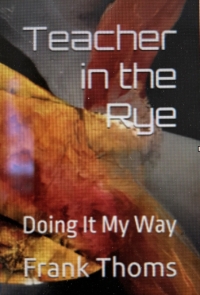
I write to bring ideas and methods from my life as a teacher in the latter half of the 20th century to help teachers and the public to “live forward” in this century. My latest book, Teacher in the Rye: Doing It My Way is available on Amazon. And I welcome comments here on my Blog or by email at frankthoms3@gmail.com.